中文
中文
 English

Why is buying a medical device more troublesome than buying a new car?
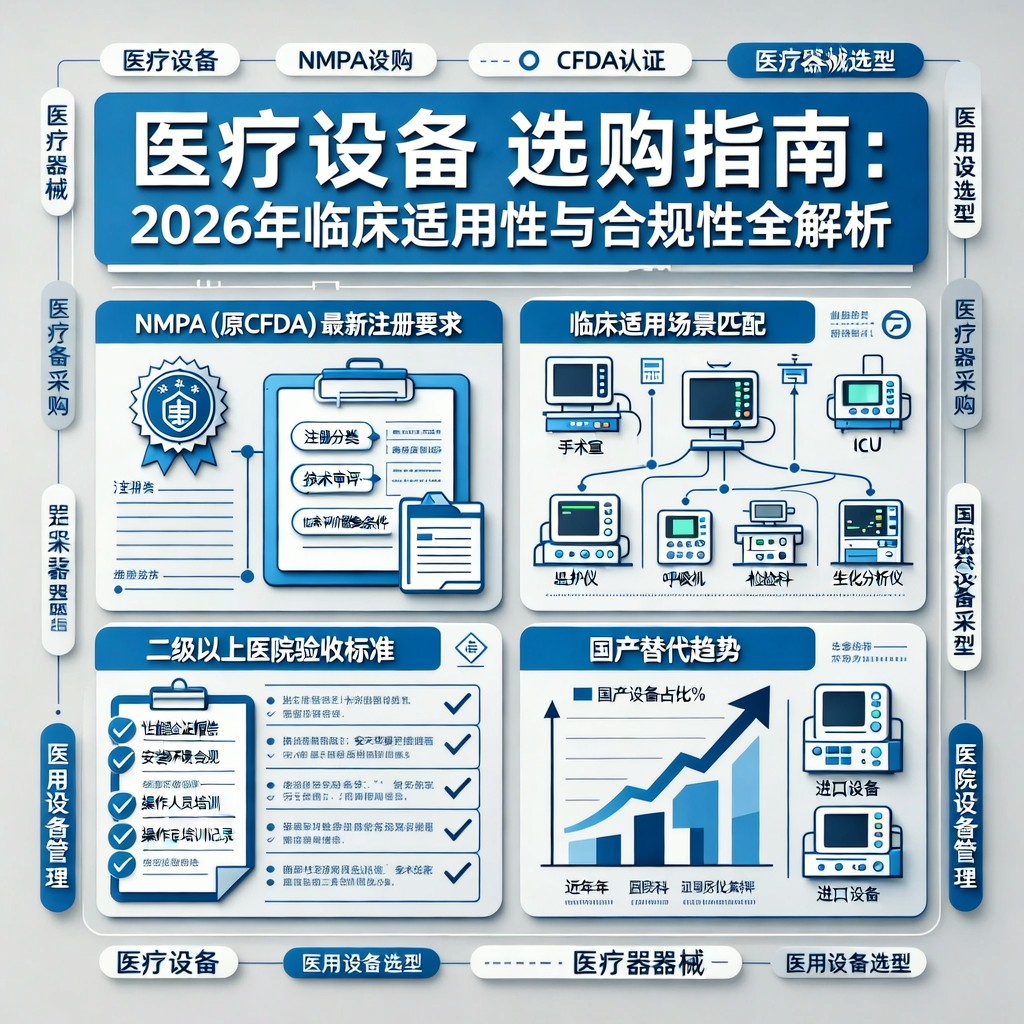
Friends, those who have worked in hospital equipment departments, procurement offices, or clinical departments responsible for equipment procurement may have a deep understanding that choosing a CT scanner, a ventilator, or even an endoscope system is not as simple as 'comparing products from three vendors and placing an order for payment'. Behind it are regulatory red lines, clinical essential needs, hard acceptance criteria, and the increasingly unavoidable pace of domestic substitution. In 2026, with the continuous strengthening of NMPA (National Medical Products Administration) supervision, equipment acceptance in hospitals above the second level is becoming increasingly stringent. Today, let's use plain language to break down the 'difficult scripture' of medical equipment procurement, page by page.
Step 1: Look at the 'ID card' first - CFDA certification (now called NMPA registration) is not just for show. Don't search for 'CFDA certification' anymore. Now it's uniformly called 'NMPA medical device registration/filing'. From 2026 onwards, all Class II and Class III medical devices sold and used within the country must hold a valid 'Medical Device Registration Certificate'; Class I devices only need to be filed. Here's the key point: The registration certificate is not permanent - it has an expiration date (usually 5 years for Class III devices), and an extension application must be submitted before it expires. Moreover, the scope of application, structural composition, model specifications written on the registration certificate cannot be exceeded in any way! For example, if you purchase a CT scanner with AI-assisted diagnosis for lung nodules, but this feature is not written on the registration certificate, then this function cannot be used as a diagnostic basis in clinical practice, otherwise it is illegal.
Tips: Log in to the 'Medical Device Query System' on the NMPA official website, enter the product name or registration certificate number, and you can verify its authenticity in 30 seconds. Never believe verbal promises like 'the certificate is in the process' or 'it will be submitted next week' - no certificate = no installation, no charging, and definitely no inclusion in medical records.
Step 2: Clinical practice is not a laboratory, equipment must be 'down-to-earth'. No matter how impressive the parameters are, if they don't solve the actual problems in the department, they are just for show. Let me give you a few real-life scenarios: The emergency department needs a portable ultrasound that 'can scan and produce images within 5 seconds after being turned on', not a high-end model that requires a 10-minute warm-up just to pursue ultimate resolution; the laboratory department in a grassroots hospital has limited space and frequent staff rotation, so when considering a fully automatic biochemical analyzer, priority should be given to user-friendly Chinese operation interface, straightforward fault codes, and foolproof consumable replacement; when purchasing an electrosurgical unit for the operating room, besides power and mode, it is more important to pay attention to the grip feel of the handle and whether the smoke suction interface matches the existing smoke exhaust system - these details often determine whether a device is 'used every day' or 'left gathering dust'.
Suggested approach: Let frontline doctors, nurses, and technicians participate in the entire process of model selection and trial use, involving at least three typical cases. Don't just listen to the manufacturer's PPT. Remember this: clinical applicability is not on the brochure, but in front of the operating table, beside the patient's bed, and at three o'clock in the morning when the night shift is busiest.
Step 3: Acceptance is not a mere formality, and hospitals at or above the secondary level are keeping a close eye on it. According to the 'Regulations on the Management of Medical Equipment in Medical and Health Institutions' and the latest notices from local health and wellness commissions, hospitals at or above the secondary level implement 'tripartite acceptance' for equipment costing over ten thousand yuan - the equipment department, the using department, and a third-party metrology/testing institution are all indispensable. The new focus in 2026: network security compliance review (especially for imaging equipment and remote monitoring systems, which must meet the requirements of Classified Protection 2.0), data interfaces must comply with the 'Guidelines for the Implementation of Unique Device Identifiers (UDI) for Medical Devices', and operation manuals and training records must be complete and archived. There was once a tertiary hospital that had its entire batch of equipment rejected due to the ventilator not providing a test report that met the new safety regulations of GB 9706.1-2020, resulting in the contract being directly voided.
Highlight: The acceptance report is not just a matter of signing off. It must be uploaded to the provincial medical equipment management platform along with the purchase contract, photocopy of the registration certificate, factory inspection report, installation and commissioning records, and operation training sign-in sheet - all with traceability and lifelong responsibility.
Step 4: Domestic substitution is not just a slogan, but an ongoing supply chain restructuring. From the cancellation of 'import priority' for large medical equipment configuration licenses in 2023, to the expansion of national procurement to categories such as ultrasound, endoscopy, and anesthesia machines in 2025, and to the inclination of medical insurance payments in many regions towards domestically produced equipment that have passed the 'special approval procedure for innovative medical devices' in 2026, domestic substitution has moved from policy advocacy to an operational acceleration phase. However, we must also view it rationally: not all domestic products are mature, nor are all imports irreplaceable. The key lies in two aspects: first, the self-reliance rate of core components (such as whether CT tubes, MRI superconducting magnets, and endoscopic image sensors are self-developed and self-produced), and second, clinical real-world data (whether there are stable operation cases in top-tier hospitals for more than two consecutive years, and whether maintenance response is provided within 48 hours).
A smart approach is to 'replace core equipment step by step, promote consumable support simultaneously, and deeply integrate information systems' while ensuring safety and effectiveness. For example, replace the sample pre-processing module in the inspection line first, and then gradually upgrade the analysis unit, avoiding the compatibility risks and training gaps brought by 'making a one-step change'.
Finally, let me give you a piece of honest advice: The essence of medical equipment procurement is to 'use today's decisions to pay for clinical safety, operational efficiency, and disciplinary development in the next five or even ten years.' It tests not only budget control ability, but also regulatory comprehension, clinical insight, and cross-departmental collaboration. Don't be afraid of asking questions like 'Does this certificate cover my purpose?' 'Can this parameter run stably at full capacity in our ward?' 'If it breaks down after three years, where can I find the parts and engineers?' Once the answers are clear, the path will be steadfast.
Creative Statement: The content is generated by AI based on reference materials. Please carefully verify its authenticity.